
USFans Shipping: Compare the Parcel You Will Actually Send
USFans shipping cost is a parcel question, not just a product-price question. Before comparing services, identify the items you intend to send, the destination and the relevant packed measurements. A quote for somebody else's haul cannot price yours simply because both contain clothing.
Start your comparison after deciding what belongs in the parcel. Keep items still under review separate from items you are ready to send. The ordering guide explains how the product and international-parcel stages fit together.
Give every shipping comparison the same starting point
Use one consistent set of inputs when comparing the available choices:
- Destination country and any required postcode or delivery-area details.
- Actual contents and quantities, including item characteristics relevant to restrictions.
- Packed weight, rather than the sum of unwrapped product estimates alone.
- Package dimensions in the units requested by the service.
- The service conditions, included options and date of the displayed amount.
If one of those inputs changes, recheck the comparison. A quote for a different destination or a smaller package is not evidence that the service will be cheaper for the parcel you intend to send.
For a clothing candidate, inspect this hoodie on USFans and settle its colour, size and quantity before adding it to the parcel plan. Use the prepared parcel's measurements for shipping, rather than estimating its packed weight from the product photograph.
Actual weight and volume answer different questions
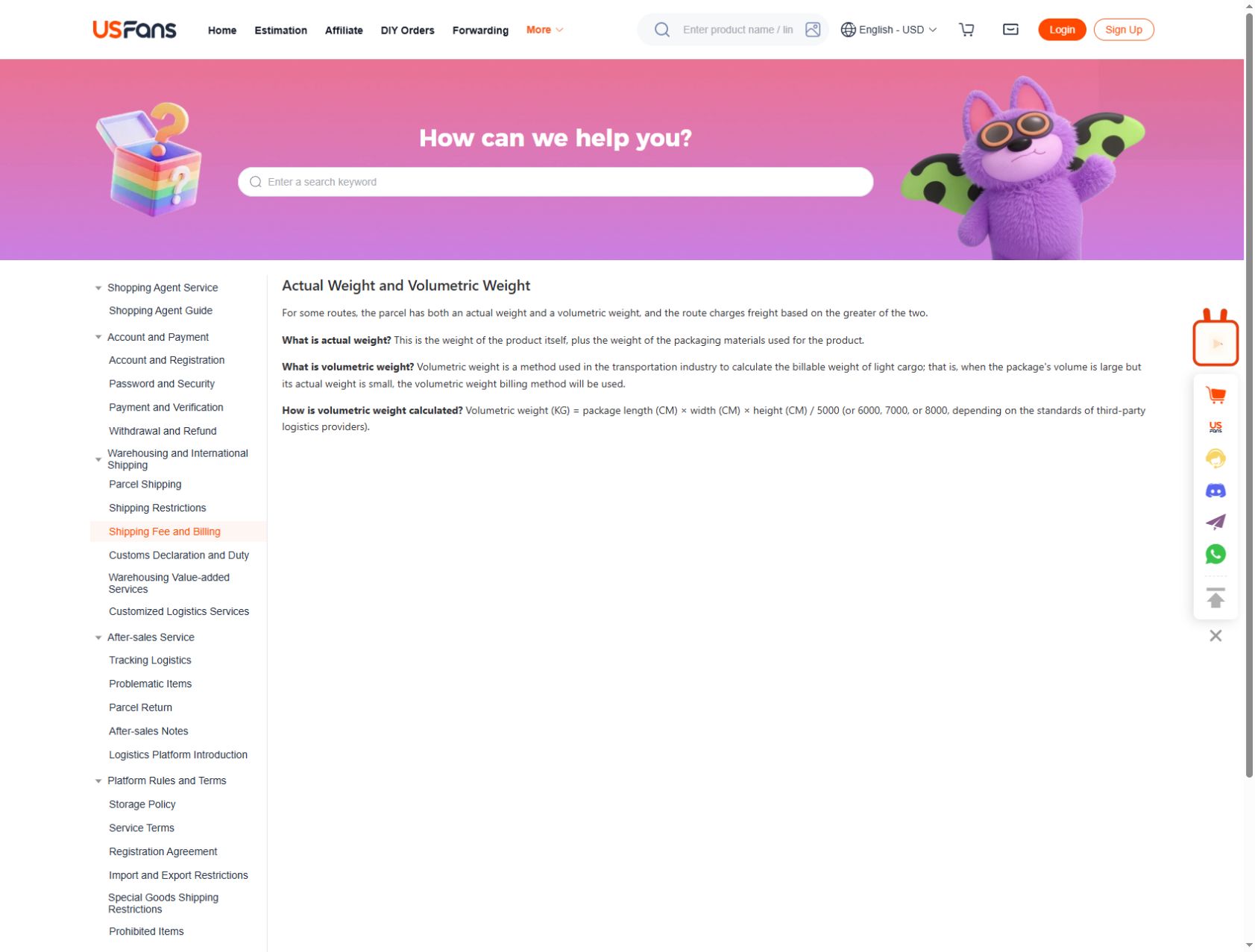
USFans' actual-and-volumetric-weight guidance, checked on 30 September 2026, includes packaging in actual weight. For some routes, the larger of actual and volumetric weight determines the billing basis. The applicable divisor depends on the logistics provider's standards; do not apply one divisor to every route.
Here is a calculation example, not a quote or a measured customer parcel. Suppose a package measures 40 × 30 × 20 centimetres and weighs 3 kilograms. Its volume is 24,000 cubic centimetres. With a divisor of 6,000, the volume-based figure is 4 kilograms; with 5,000, it is 4.8 kilograms. Those different figures show why the route's actual rule matters.
The result is still not a price. Applicable weight rounding, rate steps, service options and the displayed conditions need to be checked for the chosen route. Use the shipping calculator guide to keep an estimate's assumptions visible to yourself.
Compare the full arrangement, not one headline number
Read what the displayed amount covers. Keep the product purchase, domestic transport, international parcel and any other applicable service charges distinguishable. Do not assume that a label or a community description includes every possible charge.
If you compare a combined parcel with separate parcels, compare the entire proposed arrangement. For example, the cost of the first small parcel alone does not represent the cost of sending all the items separately. Use the same contents and destination for both plans, then consider any differences in handling and protection.
Likewise, an estimate made before packing may differ from information shown after packing. Look for the changed input before assuming the difference is an unexplained price increase. It may be necessary to ask support which measurement or service condition was used.
Packaging is part of the decision
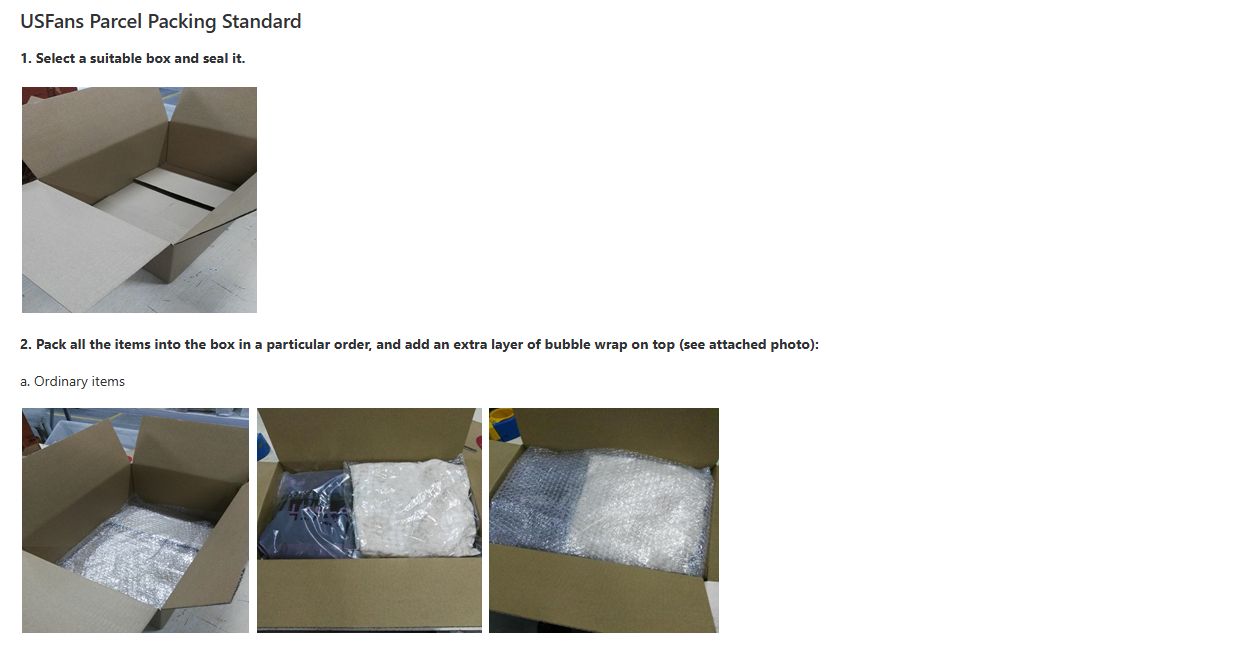
Reducing packaging can affect size and weight, but it can also change protection. Do not remove a box or protective material merely because another buyer did so successfully. Consider the item you are sending and the consequences of damage.
A bulky, light item may create a different comparison from a compact, heavier one. The numerical example above illustrates that distinction without promising a particular saving. The right comparison is between the actual packaging choices available for your parcel and their effects on both the calculation and the protection required.
Resolve item questions before confirming the parcel. If you are still checking the selected size or visible condition, use the QC guide and warehouse guide first. A shipping decision should not silently replace an unresolved product decision.
Check destination and contents together
Do not infer delivery availability from the language of a spreadsheet or a review. A Spanish-language guide does not, by itself, establish a route to Spain, Mexico or Argentina. Enter the destination relevant to your order and inspect the services actually offered for its contents.
If no suitable choice appears, check the inputs and ask a specific question rather than changing the product description to bypass a restriction. Different item types may require different handling. A route previously used for garments is not automatic evidence for a parcel containing other products.
Save the choices returned for your actual destination and contents, including the quote date and billing inputs. If the intended service is missing, ask which condition rules it out before changing the parcel plan.
Separate shipping time from the entire order timeline
An order can involve seller preparation, movement to the warehouse, warehouse handling and international delivery. When reading a time estimate, identify where the stated period begins and ends. Do not count a carrier estimate as a promise covering every earlier stage.
A message about asking a seller to ship concerns a different stage from a parcel already moving internationally. Keep the product-order record separate from the parcel record so you can ask about the correct delay. The delivery-time guide covers that distinction, and the tracking guide covers parcel updates.
If a tracking event mentions a delivery point, inspect the carrier's explanation and any collection instructions for that parcel rather than assuming it has reached your home. Keep personal address and parcel details out of public screenshots when asking for help.
Before confirming the parcel
Review the contents, measurements, destination and selected service once more. Save the relevant amount and conditions privately with your parcel reference. Recheck any change that would affect the choice rather than carrying forward an earlier estimate unchanged.
If something is unclear, ask support a concrete question: which input or condition explains the displayed result? That is easier to resolve than a comparison with an unrelated screenshot.
Can I use a friend's shipping receipt as my budget?
It can provide an example of their parcel, but not a quote for yours. Differences in destination, contents, packaging, timing or service can make the comparison unsuitable.
Does consolidation always save money?
Do not assume so. Compare the complete combined and separate arrangements using the actual relevant inputs and service conditions.
Why can a lightweight package produce a larger billing figure?
Some routes consider package volume as well as actual weight. Check the applicable rule and measurements before drawing a conclusion about the charge.
Does USFans ship to Hong Kong?
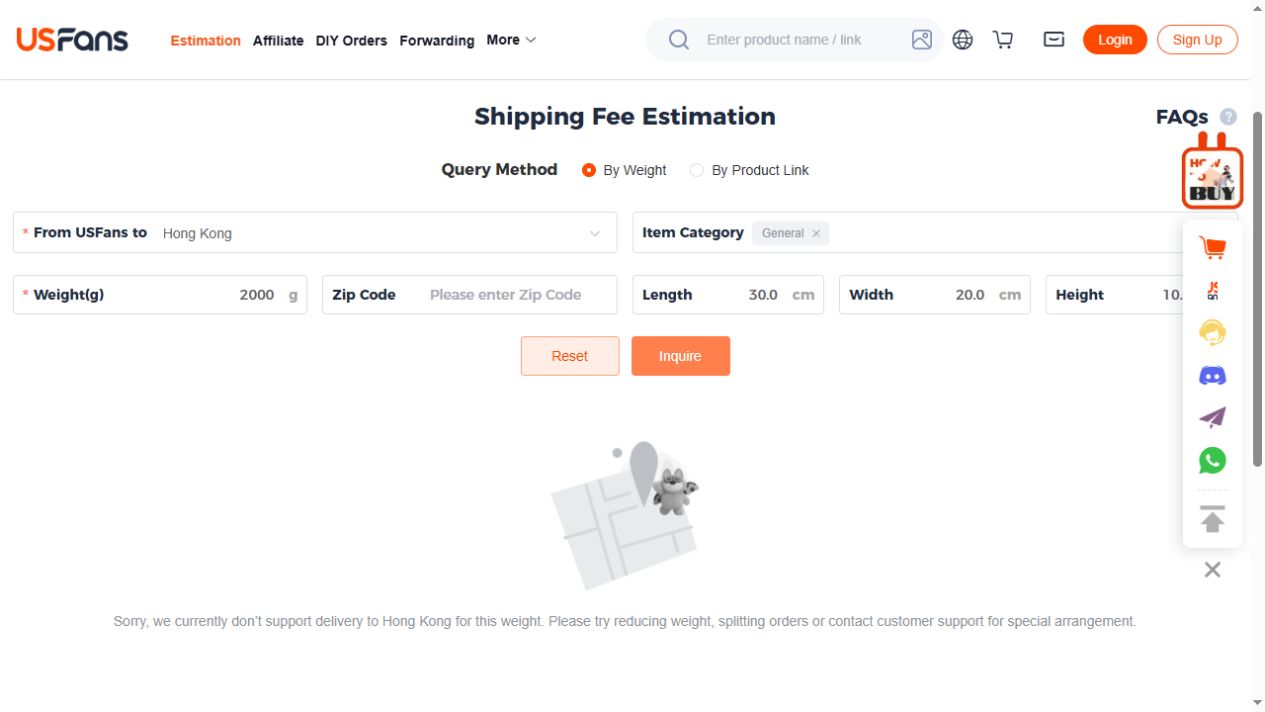
The public estimator returned no service for the following Hong Kong example on 1 October 2026.
| Input | Tested value |
|---|---|
| Contents | General clothing |
| Weight | 2,000 g |
| Size | 30 × 20 × 10 cm |
| Postal code | Not entered |
Before adding goods to a parcel intended for Hong Kong, establish that the current service conditions cover them. This example supplies no usable Hong Kong quote.
For destination-specific examples, see Mexico and Argentina in the Spanish shipping guide.